

Short answer: Plan around the time you will be ready to board, not your scheduled landing time. Then match your terminal and destination to a late-night bus route and confirm that route’s departure table with the operator for your travel date. If no listed route fits, decide on a taxi or a wait before you fly.

| Terminal | Destination area | Route to check | Notes |
|---|---|---|---|
| T1 | Gangnam Express Bus Terminal | N6000 | Adult KRW 17,000, child KRW 10,000 |
| T1 | Cheongnyangni, Hongdae | N6002 | Adult KRW 17,000, child KRW 10,000. Hongdae is on the airport’s stop list |
| T1 | Dongdaemun Design Plaza, Mapo, Seoul Station | N6701 | Adult KRW 18,000, child KRW 12,000. Mapo and Seoul Station are on the airport’s stop list |
| T1 | Gwangnaru Station, COEX, Jamsil Lotte World | N6703 | Adult KRW 18,000, child KRW 12,000. COEX and Jamsil Lotte World are on the airport’s stop list |
| T2 | Any | Use the T2 page | Separate departure table. Late-night stop listed as B1. Routes pass T1 |
Fares are as shown on the airport’s T1 page on 2026-10-04 and may change (Incheon Airport, T1). Do not apply T1 fares or times to T2.
1. Choose your terminal and estimate your real ready time
Check your airline confirmation for T1 or T2. The airport publishes late-night bus information separately for each terminal: T1 and T2.
Your ready time is the moment you are through arrival procedures, hold your bags and are standing at the boarding point. It is later than landing, and the airport pages do not promise a landing-to-bus connection. A simple method:
- Take the scheduled landing time.
- Add your own allowance for arrival procedures, baggage and finding the stop. Make it larger if you are checking bags.
- Treat the result as your earliest realistic departure.

2. Find the next real departure after that time
Open the departure table for your terminal and travel date. Pick the first departure after your ready time, and note the one after it as backup. The airport says its website is for reference and that accurate information should be confirmed with the relevant operator, so do that recheck for your date before you rely on any time or fare.
This guide gives no universal “last train” time. Which services run after you land depends on your date and arrival time, so use the tables and your operator, not an assumption.
3. Match the route to your destination
The airport’s T1 table lists intermediate stops for each route. Choose the route whose stop gets you closest to your accommodation, and compare it against your other options:
| Option | Use it when | Verify |
|---|---|---|
| Late-night bus | A listed stop is a workable starting point for your last leg | Departure table, fare and boarding location for your terminal and date |
| Taxi | No listed stop suits you, or your ready time is after the last departure | Ask your accommodation or an official airport information desk what to expect to your address |
| Wait or overnight fallback | Neither suits you | Ask the airport what is available before you rely on it |
This guide quotes no taxi fares and describes no waiting facilities. Both vary and the airport is the place to confirm them.
4. Tickets and payment on T1
According to the airport’s T1 page:
- N6000 and N6002 tickets are sold at ticket booths and automated ticket machines.
- N6701 and N6703 tickets are sold at ticket booths, automated machines and in the Tmoney GO app.
- A separate, lower fare is listed for Songjeong Station: adult KRW 10,000, child KRW 6,000. Check the T1 page and your operator for which route and boarding point it applies to.
Those are the channels the page lists. It does not promise that any particular payment card is accepted, so carry a backup payment method. For T2, use the T2 page and the operator for tickets and payment.
5. Plan the last leg from the bus stop to your door
A stop name is not an address. Before you fly:
- Ask your accommodation whether late arrival is possible and how it advises getting there from your chosen stop.
- Look at an up-to-date map of the stop-to-door route, including whether you need step-free access.
- If the last leg is unclear, choose a different stop or a taxi instead.
No route page here verifies stop-to-hotel walks or journey durations, so confirm both yourself.
6. If your flight is delayed
- Recalculate your ready time from the new landing time.
- Re-read the next departure on the official table.
- If you would miss the last suitable service, switch to your taxi or fallback plan rather than hoping for a later bus.
Before-you-fly checklist
- Terminal confirmed (T1 or T2)
- Destination matched to a route and stop
- Realistic ready time worked out, with margin
- Next two departures noted from the official table for my date
- Fare and ticket channel confirmed with the operator
- Backup payment method packed
- Stop-to-accommodation route and late arrival checked
- Taxi or wait fallback decided
- Confirmations saved offline

Sources
- Incheon Airport, T1 late-night buses, checked 2026-10-04
- Incheon Airport, T2 late-night buses, checked 2026-10-04
Update triggers
Timetable, route, fare or boarding location change; terminal change; Songjeong fare change; ticket-channel change; service suspension or operator notice.
After midnight: a practical arrival decision
Your flight landing time is not your bus boarding time. Clear immigration, collect checked bags, pass customs and identify the correct terminal before committing to a departure. The airport recommends allowing 1–2 hours for immigration when booking transport; queues and baggage delays can change this.
1. Prepare the exact destination
Save your accommodation name, full Korean address, reception contact, check-in deadline and entrance instructions offline. Record the nearest useful stop and the final walking route. Contact the accommodation before arrival if late check-in requires a door code or advance arrangement.
2. Choose your terminal, not a generic airport route
Use the terminal-specific official late-night bus page below. Confirm the route destination, departure date, next departure, ticket method and signed boarding bay. A service from Terminal 1 does not establish a departure from Terminal 2. Do not transfer terminals merely because an old screenshot lists a bus there.
3. Check the entire journey before paying
Compare the wait, road journey and final leg. A bus to Seoul Station is useful only if you can complete the onward journey after arrival. A daytime subway route is not proof of an available late-night connection. Keep luggage handling, stairs, weather, children and accessibility needs in the decision.
4. Find the ticket counter and signed bay
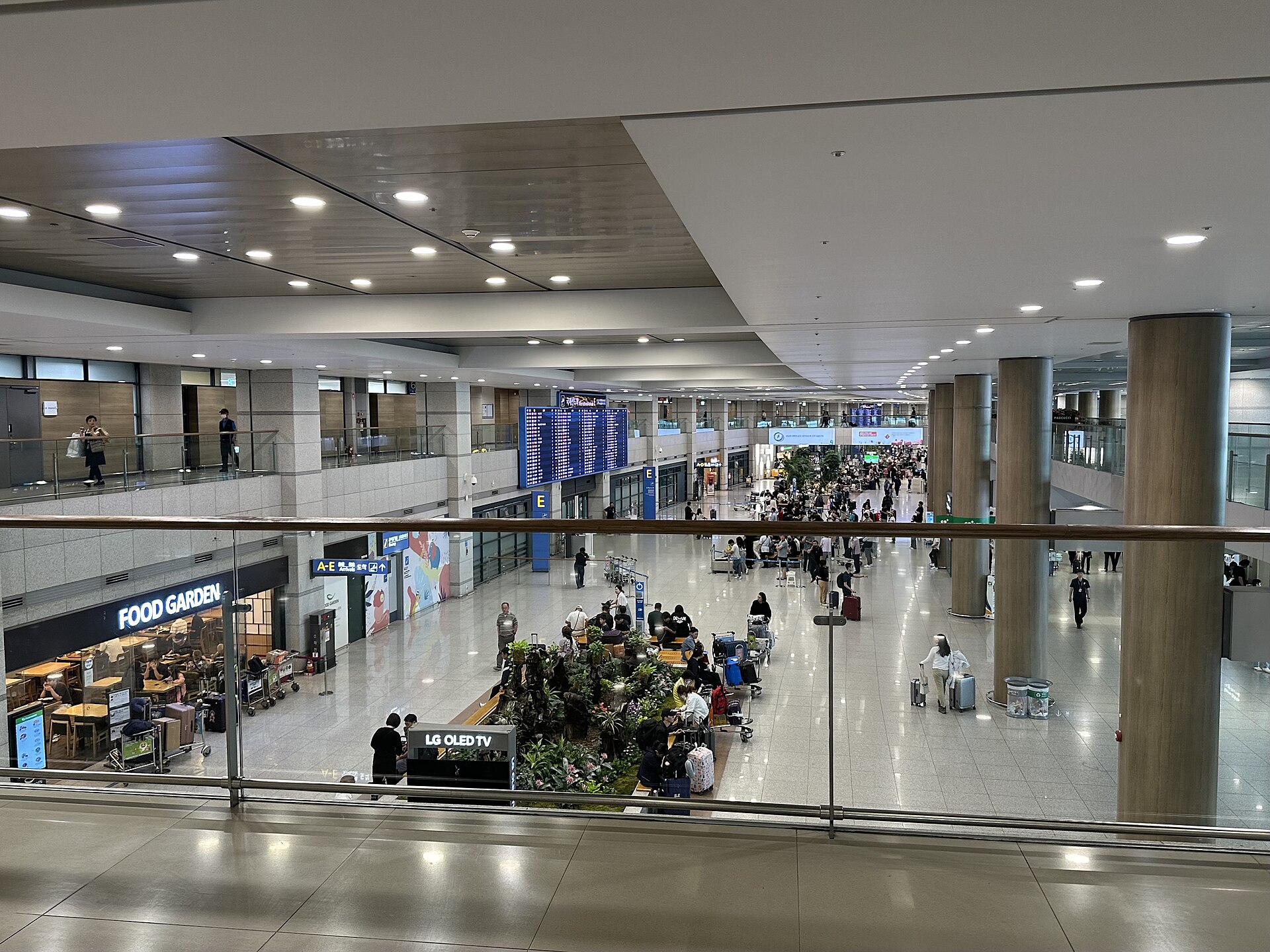
At Terminal 1, airport guidance lists indoor bus ticket booths beside exits 4 and 9, and outdoor booths near exits 4, 6, 7, 8, 11 and 13. These are ticket locations, not a guarantee of overnight opening or your route’s boarding bay. Check the terminal signs and official route information.
5. When rail or buses do not fit
Check a signed airport taxi rank or an arranged transfer with your full destination. Confirm passenger and suitcase capacity, fare method, tolls and destination before departure; retain the receipt. If you booked a pickup, confirm the meeting point and how delays are handled. Do not rely on unsolicited approaches in the arrival hall.
6. If you need to wait
Ask the airport information desk which waiting facilities are open in your terminal, where you may remain and whether a nearby accommodation has availability. Keep your phone charged and your accommodation informed. A planned wait is preferable to a connection whose final leg you cannot complete.
Check your departure here
- Terminal 1 bus stops and ticket information
- Airport rail access and operator information
- Airport taxi and call-van guidance
Reference pages checked 9 October 2026. Departure times, seat availability and taxi totals are not live data on this page. Confirm the actual journey with the operator.
