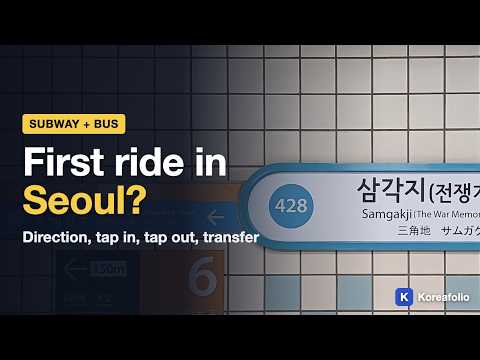
Compare the subway, buses, airport rail, airport coaches, taxis, transport cards, cycling and accessibility. Choose by luggage, arrival time, destination and access needs.
Start with the destination, then check the service.
Copy your destination’s full address. Compare rail and direct buses, check your terminal and last departure, and keep a late-arrival fallback. Official fares below retain their published basis dates; they are not live quotes. No booking, fare calculator or live vehicle tracking is connected.
YOUR FIRST JOURNEY, STEP BY STEP
See how to use Seoul buses and the subway
Start with the full address, choose the route direction and check the final walk. These instructions explain the journey; current departures and service changes must be confirmed with the operator.
Recognise your bus
Green branch bus in Seoul.
Read the route number and destination before boarding; colour alone does not identify your journey.
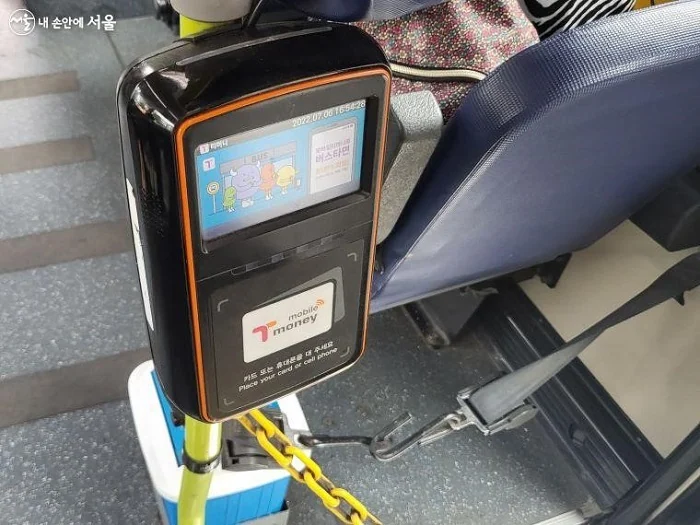
Tap your own transport card when boarding and leaving. Check the route number and direction before boarding.
The city describes a 30-minute transfer window, extended to 60 minutes from 21:00 to 07:00, and up to four transfers. Same-route and same-vehicle exclusions apply.
Different people’s journeys should be planned separately when transferring to the subway. Check coverage before choosing an unlimited pass.
Check the station, direction and last useful connection
Look up a station timetable here
Choose the station and line, then the service-day category. Published schedules are not live train positions. After-midnight times may belong to the preceding service day. Confirm holiday arrangements with the operator.
Identify the exact departure and destination stations. Save the Korean names as well as the English names.
Choose the service day and direction in the operator’s timetable.
Check the last connection as well as the first leg. Leaving the airport before the final train is not enough if your transfer has ended.
Compare the station exit, lift access and final walking distance with your luggage and mobility needs.
Station departures are checked through the official operator. Koreafolio does not invent departure times or vehicle positions.
PLAN THE WHOLE RAIL JOURNEY
Find your rail route and see its stops.
Choose two stations, a service-day category and your departure time. Read the official stop sequence and transfer details here, then locate the stops on a geographic Seoul overview. This is a published-schedule lookup, not live train tracking or a door-to-door walking route.
Select the day category matching the operator’s service calendar. Holiday arrangements and after-midnight services need confirmation with Seoul Metro. The map shows actual station coordinates on an offline geographic background; it does not draw an unverified railway path between them.
Official instructional photographs illustrate published guidance; they do not establish today’s route, vehicle or station conditions. References reviewed 9 October 2026.
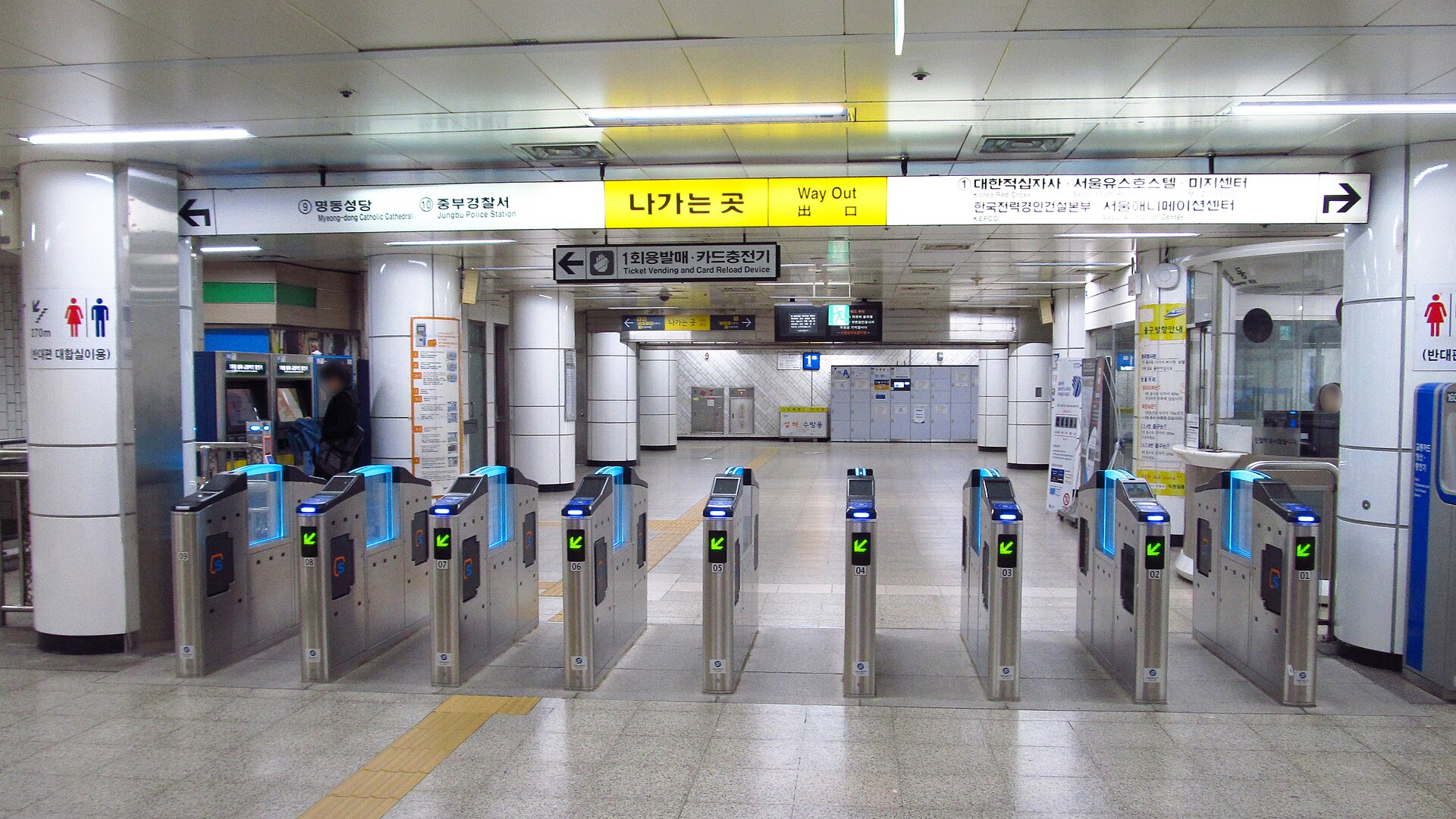
Ticket gates and direction signs at Myeongdong Station. Check your destination and line before entering.
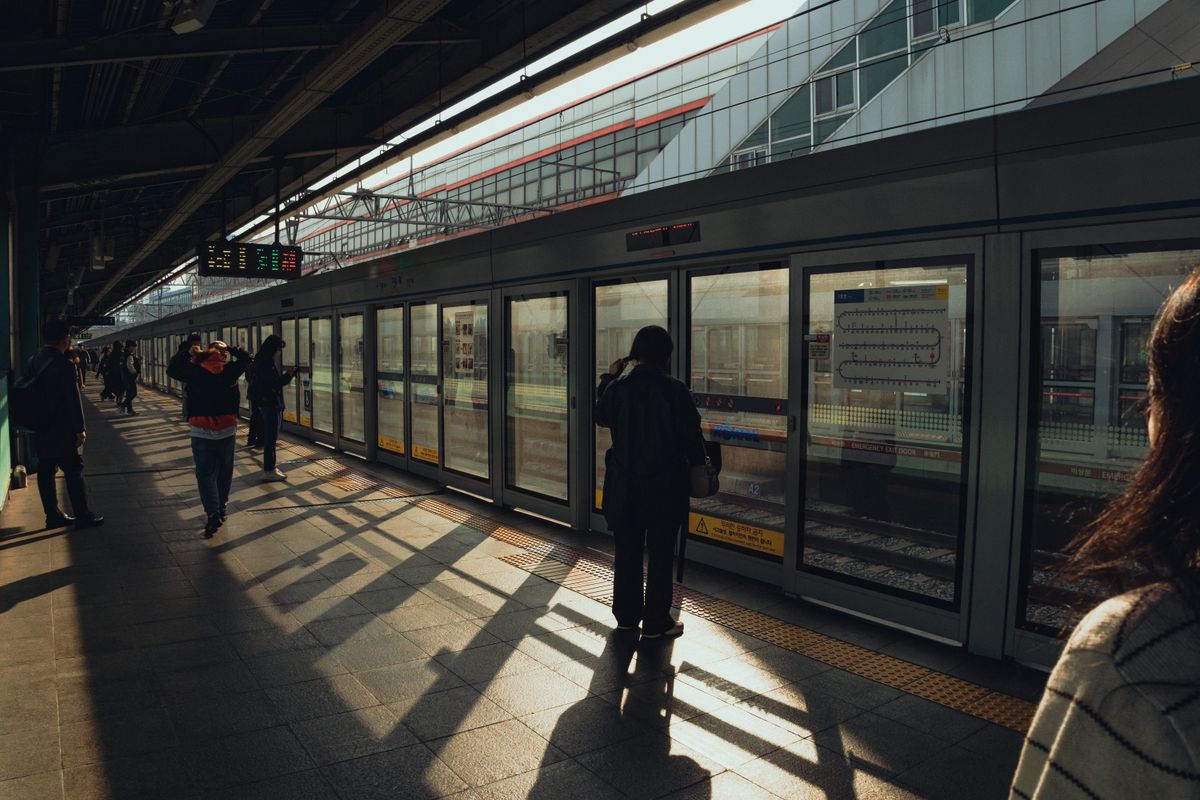
Seoul subway is the easiest default for most visitors: dense coverage, color-coded lines, multilingual signs/announcements, and official route/timetable tools. It works with a transportation card or single-journey tickets from station kiosks.
Best for
Fast cross-city trips, avoiding road traffic, airport-to-city connections via AREX transfers, and travelers who prefer predictable station-to-station navigation.
How to use it
Use a transit card for repeated rides, or buy a single-journey ticket for subway-only trips. Use official Seoul Subway/Seoul Metro station search or route apps for route, transfer, fare, and last-train checks before traveling late.
Watch for
Do not assume trains run overnight. Check the exact station, direction, weekday/weekend/holiday timetable, and last-train result before late plans. Some private or regional lines may have different coverage or fares.
Published fare reference, with basis date
Seoul Metropolitan Government fare table states subway fares as of Sat, Jun. 28, 2025; observed 2026-10-06.
adult Base Transit Card: KRW 1,550 after Jun. 28, 2025 per SMG subway fare table; distance-based additions may apply
adult Base Single Ride: KRW 1,650 after Jun. 28, 2025 per SMG subway fare table
Sources checked 6 Oct 2026. Check current operator notices before your journey.
GETTING AROUND SEOUL
City buses and bus colors/categories
Seoul blue city bus route 720, photographed 6 March 2019. Archival vehicle/route context only; verify current routes, stops and fares separately.
Seoul buses fill gaps between subway stations but can feel complex for first-time visitors. Official categories are color-coded: blue trunk, green branch/local, yellow circulation, red rapid/metropolitan, plus customized, airport and midnight buses.
Blue · trunkGreen · branch/localYellow · circulationRed · metropolitan/rapid
Best for
Short neighborhood hops, places not close to subway exits, scenic street-level travel, and direct routes when a map app shows a simple bus option.
How to use it
Prepare a transportation card, check the route and direction before boarding, tap on when boarding and tap off when leaving if using a card. For transfer discounts, tap off and transfer within the official time window.
Watch for
Buses in the same stop can go in different directions. Same-route/same-vehicle re-boarding does not count as a transfer. Multi-passenger transfer rules are limited and subway transfer discounts are not applied to multi-passenger boarding.
Published fare reference, with basis date
Seoul Metropolitan Government bus fare table states fares as of 3 AM on Sat, Aug. 12, 2023; observed 2026-10-06.
adult Trunk Branch Card: KRW 1,500 per SMG table
adult Rapid Card: KRW 3,000 per SMG table
adult Local Card: KRW 1,200 per SMG table
transfer Increment: Base fare up to 10 km, then KRW 100 per additional 5 km per SMG integrated fare description
Sources checked 6 Oct 2026. Check current operator notices before your journey.
GETTING AROUND SEOUL
Airport Railroad AREX: all-stop vs express
A'REX (Incheon International Airport Railroad) 2000-series EMU, photographed 21 January 2009. Archival train-identification context only; fleet appearance and service details can change.
AREX is the rail link between Incheon Airport, Gimpo Airport and Seoul Station. Official airport pages point travelers to the Airport Railroad official site/hotline for fares and schedules; the key planning distinction is express/reserved non-stop service versus all-stop commuter-style service with intermediate stations.
Express: airport ↔ Seoul Station
Airport terminal → Seoul Station. Use the express product’s own ticket and timetable.
All-stop: intermediate stations matter
Airport terminals · Gimpo Airport · Hongik University · Gongdeok · Seoul Station
Selected station references only. Not a full route map or a timetable.
Best for
Airport-to-Seoul Station trips, airport access when traffic is a concern, and travelers whose destination is near Seoul Station, Hongik University, Gongdeok, Digital Media City, Gimpo Airport, or another AREX station.
How to use it
At Incheon Airport, follow signs to the Transportation Center/B1 Airport Railroad area. Confirm your terminal, train type, destination and timetable on the official AREX site or at ticket machines/counters. Use the all-stop train when your target is an intermediate station; use express when you want the non-stop Seoul Station airport-train product and the schedule/seat availability works.
Watch for
Do not assume every airport train is express or that all-stop and express use the same ticketing flow. Late arrivals need a current last-train check; airport pages explicitly refer fare/schedule details to AREX official channels.
Sources checked 6 Oct 2026. Check current operator notices before your journey.
GETTING AROUND SEOUL
Airport limousine buses
Plan for luggage before choosing a coach transfer. AI-generated illustration; not an actual location, operator or product.
Airport limousine buses connect Incheon Airport with many Seoul districts and hotels, but route availability, fares and timetables are route-specific. Use Incheon Airport's official bus search and terminal bus ticket/location pages rather than relying on a generic route list.
Best for
Travelers with luggage, hotel-area drop-offs, destinations not convenient by subway, and late-night options when a current official route exists.
How to use it
Start with Incheon Airport Bus Search, choose Seoul or another region, then choose the route/destination. At T1, official ticket booths and information are inside near exits 4 and 9 and outside near exits 4, 6, 7, 8, 11 and 13. Check terminal boarding location, destination stop, ticketing method and timetable before exiting arrivals.
Watch for
Do not invent airport bus routes from memory. Incheon Airport warns to consider immigration time before booking transport and says bus operation questions should go to the relevant bus company or local government. Most airport limousine buses are not equipped for people with disabilities according to Visit Seoul accessibility guidance.
Sources checked 6 Oct 2026. Check current operator notices before your journey.
GETTING AROUND SEOUL
Taxis: ordinary, deluxe/international and metered surcharges
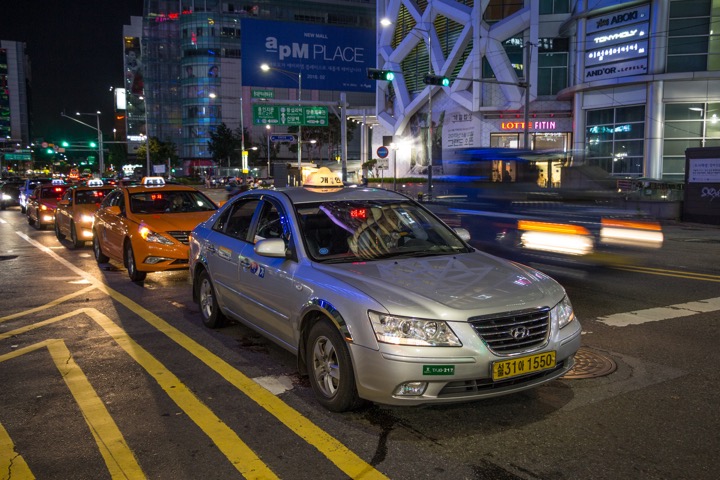
Taxis waiting for passengers in Seoul, photographed 8 August 2015. Archival taxi context only; fares, vehicle types and surcharge rules can change.
Seoul taxis include ordinary/sedan taxis, SUV/van/deluxe taxis, international taxis and app/brand products. For a visitor overview, focus on metered official fares and surcharges rather than estimating trip prices.
Keep the destination addressCheck taxi type & meterConfirm surchargesKeep the receipt
Best for
Short trips with luggage, late-night movement after transit ends, accessibility or mobility needs when subway/bus is inconvenient, and destinations far from stations.
How to use it
Use official meters or an approved fare plan. Ordinary sedan taxis are the common baseline; deluxe/SUV/van taxis have higher base and distance/time fares. International taxis use the same metered fare as sedan/SUV/van/deluxe plus an international passenger surcharge unless using an approved section/charter fare.
Watch for
Late-night and outside-city surcharges can stack. SMG states all taxis must charge only by the meter except separately approved fare plans. Tolls requested by the passenger are collected separately at actual amount.
Published fare reference, with basis date
Seoul Metropolitan Government taxi table states sedan and SUV/van/deluxe fares as of 4 AM on Feb. 1, 2023; observed 2026-10-06.
sedan Day Base: KRW 4,800 up to 1.6 km; KRW 100 per 131 m; KRW 100 per 30 s
sedan Night Surcharge: Late-night surcharge: 20% 10 PM-11 PM, 40% 11 PM-2 AM, 20% 2 AM-4 AM; outside-city surcharge 20%; late-night outside-city up to 60%
deluxe Suv Van Day Base: KRW 7,000 up to 3.0 km; KRW 200 per 151 m; KRW 200 per 36 s
international Metered: Same as sedan/SUV/van/deluxe taxi fare plus 20% international passenger surcharge; sedan multiple surcharge can total up to 60% with late-night and outside-city surcharges
Sources checked 6 Oct 2026. Check current operator notices before your journey.
GETTING AROUND SEOUL
Walking, cycling and Ttareungi visitor eligibility
Seoul public bicycles at a rental station.
Seoul is highly walkable in many districts, and Ttareungi/Seoul Public Bike is the official public bike system with rental stations near subway exits, bus stops and popular pedestrian areas. Official Seoul pages describe it as usable anywhere, anytime by anyone and designed for broad user groups.
Check visitor eligibility and paymentChoose a suitable walking / cycling routeConfirm service rules and return process
Best for
Short local trips, riverside or park riding, station-to-destination gaps, and travelers who want street-level exploring rather than another subway transfer.
How to use it
Use the official Seoul Public Bike website/app to find nearby stations, rent and return at any station. Scan the QR reader on the rear wheel using the official app. For unlimited transit passes, note whether Ttareungi is included; short-term Climate Card passes specifically do not include Ttareungi.
Watch for
Do not promise foreign visitor payment flows unless verified at point of use. Ttareungi pass/payment details can change; confirm in the official app/site. Ride only where safe and legal; treat busy sidewalks and pedestrian areas cautiously.
Published fare reference, with basis date
Seoul Public Bike policy archive and Climate Card page observed 2026-10-06; official pages do not present the Ttareungi fare table with a separate fare-effective date in extracted text.
ttareungi Single Use: SMG policy archive lists single-use 1-hour KRW 1,000 and 2-hour KRW 2,000
climate Card Short Term Ttareungi: Not included in short-term Climate Card passes per SMG Climate Card page
Sources checked 6 Oct 2026. Check current operator notices before your journey.
GETTING AROUND SEOUL
Accessibility
GTX-A Seoul Station interior corridor with tactile paving and wayfinding, photographed 8 January 2025. This is accessibility context, not proof that every route or facility at Seoul Station is accessible. Archival photograph; not proof of current conditions.
Seoul has official accessibility resources for subway stations, low-floor buses, Danurim tourism support, and accessible taxis. The practical advice is to verify the exact departure, transfer and arrival station facilities rather than assuming every station or bus route is equally accessible.
Check the exact station exit and liftConfirm the venue entrance and facilitiesCheck any advance assistance booking
Best for
Wheelchair users, older travelers, pregnant travelers, families with strollers, and anyone needing elevators, accessible restrooms or assistance services.
How to use it
Check station-level elevator, accessible restroom, wheelchair ramp/lift and guidance-system data before routing. For tourism assistance, contact Seoul Danurim Tourism Center. For accessible taxis, reserve in advance and keep a backup because Visit Seoul warns demand is higher than supply.
Watch for
Some smaller/older stations may lack full facilities or have partial access. Visit Seoul says most airport limousine buses are not disability-equipped and advises not relying on accessible call vans as a primary mode because waits can be long.
Published fare reference, with basis date
Visit Seoul accessibility page states accessible taxi fleet/fare details as of 2024 in extracted text; observed 2026-10-06.
accessible Taxi From Visit Seoul: Visit Seoul lists accessible taxi base fare up to 5 km as KRW 1,500 and says no time/area surcharges apply; verify before publication if using fares prominently.
Sources checked 6 Oct 2026. Check current operator notices before your journey.
GETTING AROUND SEOUL
Practical transit cards, transfers and last-train caution
Preparing a travel card. AI-generated illustration; not an actual location, operator or product.
For most visitors, a reloadable Tmoney/EZL-type transit card is the simplest pay-per-ride tool; heavy Seoul-only riders can compare the official Climate Card short-term pass. Transfer discounts require correct tapping behavior and time windows. Late-night plans need last-train checks, not assumptions.
Buy / choose a cardCheck reload methodTap in & tap outCheck coverage & refund rules
Best for
Trip planning, cost-control guidance, visitors choosing between pay-per-ride and unlimited passes, and avoiding late-night stranded situations.
How to use it
Buy/reload a transit card at convenience stores or subway stations, tap on and tap off buses/subway to preserve transfer eligibility, and check last trains in Seoul Metro/Cyber Station or the official Seoul Subway app before evening plans. Consider Climate Card short-term passes only when staying mainly inside the covered Seoul service range and riding enough to justify a pass.
Watch for
Climate Card service range has exclusions such as Sinbundang, lines outside Seoul, airport/intercity buses and non-Seoul-licensed buses; for subway, disembarking outside the service range can trigger extra fare collection. Short-term Climate Card passes begin on the charging date and cannot be charged in advance. Transfer windows and same-route restrictions matter.
Published fare reference, with basis date
Climate Card page observed 2026-10-06; SMG transfer/fare rules state bus fares as of Aug. 12, 2023 and subway fares as of Jun. 28, 2025 where applicable.
transfer Rule: Transfer within 30 minutes of getting off, or 60 minutes from 9 PM to 7 AM; up to four transfers/five boardings per SMG Modes of Transport page
Compare provider prices and booking conditions. Some links may earn us a commission; see how our links work.
From the bus stop to the last tap
Find the correct stop and direction. Compare the stop ID, route number and next stops. A stop across the street may serve the opposite direction. Use the bus-stop display or the official city bus service for the latest arrival estimate.
Have the transport card ready. Make sure it has balance; a subway single-journey card does not pay for a bus. Stand where the driver can see you and wait for the vehicle to stop.
Board through the front door and tap once. Listen for the reader response. If it fails, ask the driver rather than walking past or repeatedly presenting several cards.
Follow the stops while riding. Compare the displayed or announced next stop with your destination. Keep bags away from the doors and priority seats available.
Press the stop button before your stop. Move safely toward the rear exit once the bus is stopping; hold a rail and avoid stepping into the road ahead of traffic.
Tap the same card at the exit reader. This records the end of your ride and matters for eligible transfers. Check your next boarding stop and direction separately.
Airport coaches are a collection of operators and routes, not one city bus network. Choose by the exact hotel stop, airport terminal and departure direction. The examples below are Airport Limousine Co. routes checked against its official English route pages on 11 October 2026; this is not every airport coach or every operator.
6001 · Central and south-central Seoul
Official route stops include Dongdaemun DDP, Myeongdong Station, Seoul Station and Sinyongsan. Compare the correct directional stop with your hotel address; a hotel name on a route does not mean door-to-door service for every property.
The operator identifies Hongdae, Jongno, Dongdaemun and Cheongnyangni on this route. Check the individual stop’s timetable rather than using a departure time from a different stop.
Find your airport’s official bus directory first, then open the named operator. Airport Limousine, K Airport Limousine and other suppliers have separate routes and terms. An N-prefixed night service is not a promise that a daytime route runs overnight.
Confirm Terminal 1 or 2 on your flight information; use that terminal’s current boarding guidance.
Choose the destination stop and direction, then read that stop’s actual timetable. Keep a fallback if immigration and baggage collection may miss the final bus.
Check fare, child eligibility, accepted payment, luggage rules and whether the ticket reserves a specific departure.
At the terminal, match the live stand sign with the route number on your ticket. Boarding bays can change.
For the return, verify the city-side stop and leave a traffic buffer. The opposite-direction stop is not always immediately across the road.
Exact live fares, availability and boarding bays remain with the airport and operator; the examples do not invent a fixed boarding point.
Rent, ride and confirm the return
Ttareungi is the city’s bike-share service. A short rental limit and the period during which a pass is valid are different things: a pass may allow repeated rentals, but keeping one bicycle beyond its rental limit can add charges.
Check eligibility before walking to a bicycle. Open the official Seoul Bike site or app and use the visitor/non-member route available to you. Check its language, identity and payment requirements; a foreign card is not guaranteed to work simply because you can see a bicycle.
Read the pass terms before purchase. Confirm the allowed time per rental, pass validity, extra charges and accepted payment. Buying a pass is an operator transaction; this page does not take payment or activate a rental.
Inspect the bike. Check tyres, brakes, saddle height and the indicated bike/QR number. Use the operator’s rental procedure for that bike model; an old docking-terminal tutorial may not match a QR bicycle.
Check unlock confirmation. Do not force the lock or ride before the app or terminal confirms the rental. If the number or unlock fails, contact the operator and use another mode.
Ride and return safely. Plan a legal cycling route, avoid crowded pavements and stop before using your phone. Return at a permitted station using that model’s lock procedure.
Confirm the rental ended. Look for the operator’s return confirmation and check the rental record before leaving. A bicycle looking parked is not proof that charges stopped. Record the bike number, station and time if a return fails.
TOPIS currently lists non-member daily 1-, 2- and 3-hour rental products at KRW 1,000, 2,000 and 3,000, and KRW 200 per extra five minutes after the base rental time (checked 11 October 2026). The current purchase screen controls the product offered to you; overseas-payment acceptance has not been transaction-tested.
For visitors comparing rental cars, use the provider’s site to confirm destination inventory, driver documents, insurance and pickup rules before booking.
Approved affiliate link · car rentals
Search car rentals with DiscoverCars
DiscoverCars opens a general car-rental search. Korea inventory is not guaranteed, so verify the exact dates, supplier and driving-document requirements.
Koreafolio may earn a commission from qualifying purchases through labelled affiliate links. Provider checkout pages control availability, prices and booking terms. Read how our links work.