
Can Under-19s Check In to a Hotel in Korea? The Age Rule and Consent Forms
Often yes, but two separate rules decide it, and they are easy to confuse. Korean law sets the age line at 19, counted by birth year rather than birthday, and it is aimed mainly at teenagers of different sexes sharing a room. On top of that, each hotel sets its own policy, and that policy is usually stricter.
Some accept 16- and 17-year-olds with a parent’s signed consent form, and some accept nobody under the age line without a parent. So the useful question is not “is it legal?” but “what does this hotel accept?”, and you want that answer in writing before you pay.
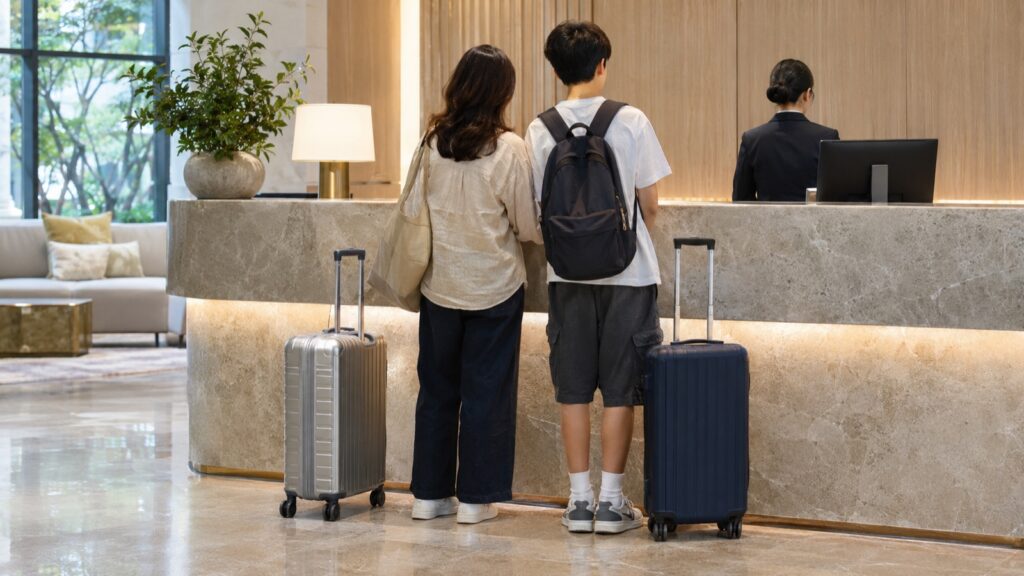
Who counts as under 19 in Korea
The Juvenile Protection Act defines a juvenile as a person under 19, but leaves out anyone who has already reached 1 January of the year they turn 19. In practice the birth year decides. For a stay in 2027, someone born in 2008 is no longer a juvenile under this law from 1 January 2027, even if their 19th birthday is in December. Someone born in 2009 still is, for the whole of 2027.
This is not the old “Korean age”. Korea moved to international age for most legal purposes in 2023, and this law simply uses its own year-based cut-off. That is why a traveller who is 18 on their passport can be treated as an adult by the law, while a hotel that counts by birthday still says no. When the two differ, the hotel’s rule is the one you meet at the desk.
| Stay in | Not a juvenile under the law if born in | Still a juvenile under the law if born in |
|---|---|---|
| 2026 | 2007 or earlier | 2008 or later |
| 2027 | 2008 or earlier | 2009 or later |
What the law actually restricts
Hotels are not places that under-19s are banned from entering. The Act lists lodging businesses among places that may not employ juveniles, not among those they may not enter. What it forbids is letting juveniles of different sexes share a room, or providing a place for that purpose. Lodging operators must check ages and refuse entry where that risk exists.
So two 17-year-old friends of the same sex are not breaking a Korean law by staying together, and a 17-year-old boyfriend and girlfriend sharing one room is exactly what the rule targets. Whether the hotel lets either group in at all is a separate matter.
What hotels actually ask for
Policies differ a lot, even between hotels in the same street. Sotetsu Hotels The Splaisir Seoul Dongdaemun publishes one of the clearest, and it shows how detailed a hotel’s rule can be:

- The person checking in must be at least 16.
- Guests aged 16 and 17 can stay alone, or two of the same sex together, with a consent form signed by a parent and a copy of that parent’s ID.
- Two minors of different sexes cannot share a room.
- Brothers and sisters can share, but the hotel also asks for an official document proving the family relationship.
- A minor staying with an adult who is not family is refused. With an adult family member, such as an older sibling, the stay is possible with the consent form, the parent’s ID copy and the family relationship document.
- Anyone 15 or younger cannot stay without a guardian, even with a form.
Its sister hotel in Myeongdong says the same about under-15s, and warns that it may refuse the stay if the form is missing at check-in. Do not assume another hotel works this way. Some set a higher minimum age, some want a parent present, and some decide case by case.
The sibling rule catches people out. An adult sister travelling with a 16-year-old feels like a family trip, but to a hotel she is not the parent. Ask specifically whether an adult sibling is acceptable and which documents prove the relationship.
Booking sites do not settle this for you. A platform may let you complete a booking with any date of birth, or none at all. Some list a minimum check-in age in the property’s house rules, but the front desk applies the hotel’s own policy on the day, and a booking confirmation is not an exception to it.
Common situations
| Who is travelling | Legal issue? | What to confirm with the hotel |
|---|---|---|
| A parent with their teenager | No | Usually nothing beyond the normal booking and ID |
| Two same-sex friends aged 16 to 18 | No, under the law | Minimum check-in age, whether a parental consent form is accepted, and the format they want |
| An adult with a younger sibling under 19 | No | Whether an adult sibling is accepted, and which consent and family documents are needed |
| An adult friend with someone under 19 | No, if same sex | Whether a non-family adult is accepted at all; some hotels refuse this |
| A school or sports group with a leader | Depends on room arrangements | The group’s room list by sex and the leader’s role; groups usually arrange this with the hotel in advance |
| A mixed-sex couple, either under 19 | Yes, if sharing a room | Expect refusal; book separate rooms |
How to get a clear answer before you pay
Write to the hotel directly, not only through the booking platform’s chat, and include the facts it needs to decide. Something like this works:
“We plan to stay on [dates]. The guests are [number] people. The guest checking in was born on [full date of birth]; the others were born on [dates]. No parent will be travelling with them. Can they check in? If a consent form is needed, please send your form or tell us exactly what it must include.”
Give the full date of birth, not just an age, because the law counts by year and the hotel may count by birthday. Ask for the reply in writing and keep it with the booking. Choose a cancellable rate until you have that answer.
If the hotel accepts a consent form, have it signed in advance and bring the original, a copy of the signing parent’s ID, and the parent’s phone number. Bring the guest’s own passport, and expect a card or cash deposit at check-in, which some hotels ask for whatever the guest’s age.
If the answer is no
Look for hotels that publish a lower minimum age with a consent form, rather than trying properties one by one at the door. Separate rooms by sex solve the legal issue for mixed groups, though not a hotel’s own age rule. If a parent can join for the first night and complete check-in, ask whether that is enough for the rest of the stay. Some hotels may agree, but do not assume it.
For the other common booking questions, see our guides to extra guests and children in Korean hotel rooms, whether to email the hotel after booking and late-night check-in.
Pages behind this advice
Checked 8 November 2026.