
Seoul to Busan by KTX: Tickets, Stations, Time and What to Book
Updated October 17, 2026
Short answer: Take the KTX from Seoul Station to Busan Station. The fastest trains take a little over 2 hours 15 minutes, while trains with more stops can take around 3 hours 30 minutes. Since 1 September 2026 the standard Seoul–Busan fare is 54,400 won one way in standard class, down from 59,800 won. Book on Korail’s English website or the KORAIL+ app; tickets usually go on sale one month ahead at 07:00. Trains from Suseo Station in southeast Seoul (the old SRT) are now part of KTX too and are sold in the same system. For one simple return trip, separate tickets cost less than the cheapest Korail Pass.
Basis date: checked against Korail’s 5 August 2026 press release on high-speed rail integration, Korail’s English Korail Pass page, VISITKOREA’s Train guide and Visit Busan’s Transportation page on 15 October 2026. Fares, timetables and pass rules change, so confirm your exact train on the official Korail booking page before you pay.
The trip at a glance
| Question | Answer |
|---|---|
| Where do I board in Seoul? | Seoul Station for most trains. Some trains use Yongsan. Former SRT trains leave from Suseo. |
| Where do I arrive? | Busan Station, the main station in central Busan. |
| How long does it take? | From about 2 hours 18 minutes on the fastest trains to about 3 hours 27 minutes on slow ones. |
| How much is a ticket? | 54,400 won standard fare in standard class (from 1 September 2026). Some trains and online specials cost less. First class costs more. |
| Where do I book? | Korail’s English website, the KORAIL+ app, station counters or ticket machines. |
| When do tickets go on sale? | Usually one month before travel, from 07:00 Korea time. |
| Is a Korail Pass worth it? | Not for one return trip. The 2-day pass is 131,000 won; two standard tickets are 108,800 won. |
1. Which Seoul station should you use?
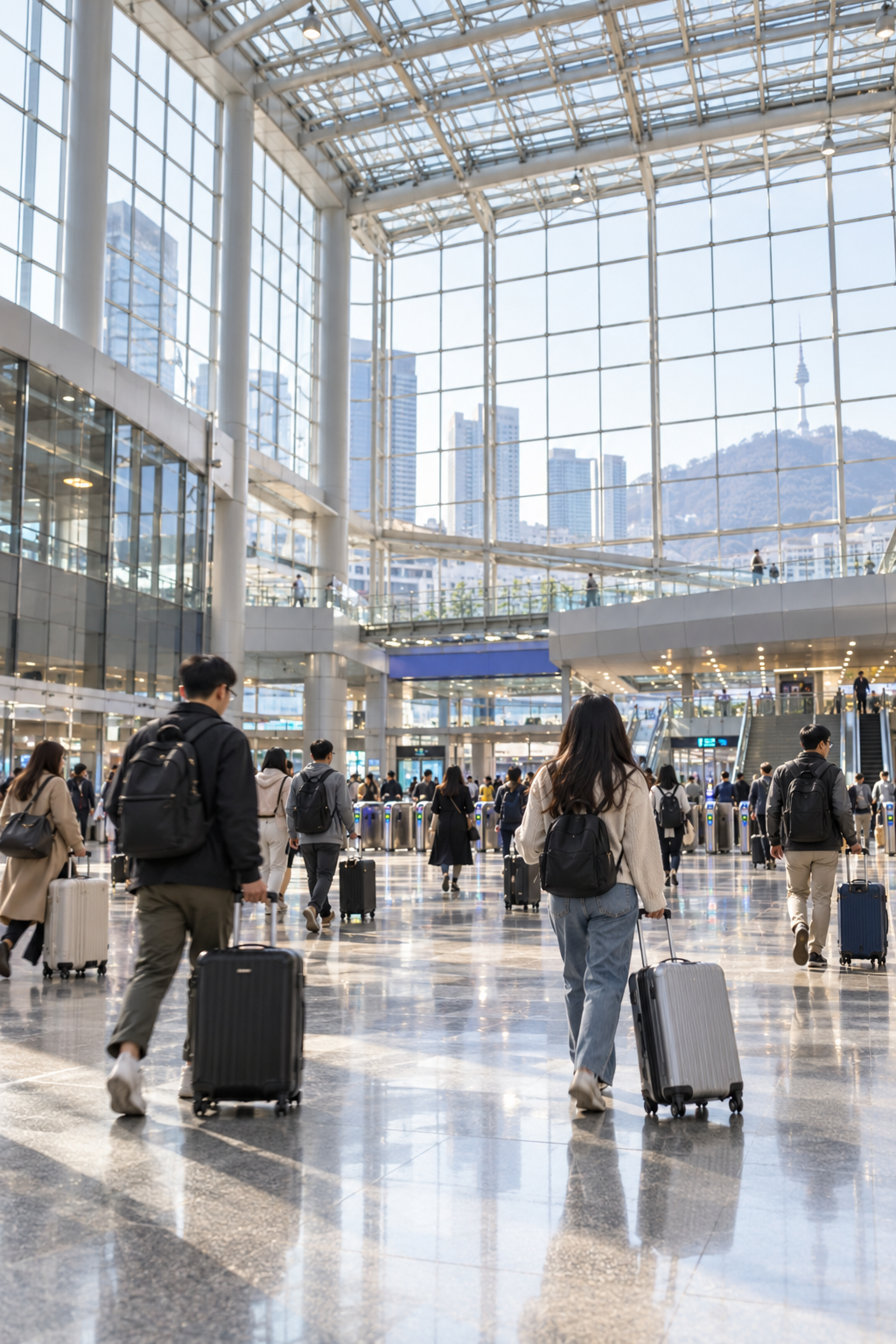
Most travelers should start at Seoul Station. VISITKOREA calls it the starting point of the Gyeongbu Line, the main Seoul–Busan route, and notes that Seoul subway Lines 1 and 4, the Gyeongui–Jungang Line and AREX (the airport railroad) all stop there. That makes it easy to reach from most hotels and directly from Incheon Airport. For subway transfers and exits, see our Seoul Subway Complete Guide.
There are two other stations you may see in search results:
- Yongsan Station: VISITKOREA lists Yongsan as another KTX departure point. Some Busan trains start or stop here, so read the departure station on your ticket carefully.
- Suseo Station: this was the home of the SRT. On 1 September 2026 Korail took over SR’s high-speed service, and the former SRT trains were renamed KTX-Sancheon. Suseo trains now show up in the same Korail search as Seoul Station trains. Suseo is on the Gangnam side of the city, so it can be the closer choice if you are staying in southeast Seoul.
Whichever station you choose, check one more thing: a few Busan trains make extra stops, such as Suwon, which adds time. If two trains have the same price, pick the one with the earlier arrival time.
2. How long the ride takes
Travel time depends on how many stops your train makes. A Chosun Ilbo report on 28 September 2026 gave the fastest Seoul–Busan KTX as 2 hours 18 minutes, and said about one in five trains from Seoul to Busan take 3 hours 10 minutes or longer. The booking screen shows the exact time for every train.
3. How much a ticket costs
Korail cut KTX fares by an average of 10% when it merged with SR. According to Korail’s press release, the Seoul–Busan fare fell from 59,800 won to 54,400 won from 1 September 2026. Treat 54,400 won as the standard adult fare in standard class. Your price can be different because:
- Trains with more stops can have a lower fare.
- Korail offers online specials of 10–30% off on trains with low occupancy.
- First class costs more than standard class. Check the price on the booking screen.
Most travelers pay by card. If you are not sure whether your foreign card will work on Korean websites, read Money and payments in Korea and have a second card ready.
4. How to book step by step
VISITKOREA lists several ways to buy tickets: a station ticket office, the Korail website, the KORAIL+ app, ticket machines, NAVER Train Booking and KakaoT. For visitors, the Korail English website and the KORAIL+ app are the most direct. KORAIL+ replaced the old Korail Talk app in August 2026; you get it by updating Korail Talk or installing it fresh. Some older guides call the website “Let’s Korail” (letskorail.com); today the booking pages sit on korail.com.
- Open Korail’s English booking page or the KORAIL+ app.
- Enter Seoul (or Suseo or Yongsan) as departure and Busan as arrival, then choose the date and number of passengers.
- Compare the list. Look at the departure station, the arrival time and the fare, not just the departure time.
- Pick standard or first class. Online, you can choose your seat in advance with the seat selection button. Some cars have seats facing both directions.
- Pay by card and save the ticket. Write down the train number, car number and seat number.
- On the day, check the departure board for your platform and go to your car number on the platform.
Tickets usually go on sale one month before the travel date at 07:00. VISITKOREA says you can buy until 20 minutes before departure, or right up to departure in the apps. Weekends, Korean holidays and the Chuseok and Lunar New Year periods sell out early, so book as soon as your plans are fixed. If you need help in English, the Korail Customer Center is listed at +82-1599-7777 (08:00–20:00 daily).
Need other travel apps? See Essential apps for Korea.
5. Korail Pass: who can use it and when it pays
The Korail Pass is a rail pass for foreign visitors. Korail says it is not available to people with Korean nationality. You choose 2, 3, 4 or 5 travel days within 10 days of the start date. The days do not have to be in a row.
| Pass | Adult (13+) | Child (6–12) |
|---|---|---|
| 2-day select pass | 131,000 won | 66,000 won |
| 3-day select pass | 186,000 won | 93,000 won |
| 4-day select pass | 234,000 won | 117,000 won |
| 5-day select pass | 275,000 won | 138,000 won |
Prices as listed on Korail’s English Korail Pass page. Korail says one child under 6 can travel free with each passenger aged 13 or over.
- Simple math: one Seoul–Busan return at the standard fare is 2 × 54,400 = 108,800 won. That is less than the 131,000-won 2-day pass. The pass starts to make sense when you add more long train rides on your pass days, for example Seoul–Busan–Gyeongju–Seoul. Add up your real fares first.
- Seats: you reserve seats separately in “My Ticket”. Korail allows up to two seat reservations per person per day. If seats are sold out, you can board standing with a valid pass and your passport.
- First class: pass holders pay 50% of the first-class fare for that route.
- What is not covered: Korail lists metropolitan railways (city subways) and temporary tourist trains as excluded. VISITKOREA’s guide still says SRT is excluded. After the merger it is not clearly stated whether the former SRT trains from Suseo are covered, so check on the official pass page before you plan around a Suseo train.
- Rules to know: the pass is for the named person only, a screenshot of a ticket is not valid, and refunds are only available before the pass start date.
For city subways and buses, use a transport card; see our T-money Complete Guide.
6. Seats, luggage and life on board
- Standard or first class: standard class is comfortable for a 2–3 hour ride. First class has wider seats and costs more; check the price difference for your train.
- On board: VISITKOREA lists restrooms, nursing rooms, diaper-changing tables and vending machines on KTX trains, and free Wi-Fi on almost all trains. The Wi-Fi can be unstable, so download maps and tickets first.
- Luggage: use the rack above your seat for small bags. Large suitcases usually go in the luggage space near the doors where your car has one. If you travel with very large or unusual items, check Korail’s current rules before you go.
7. KTX vs the old SRT: what changed
Before September 2026, Korea had two high-speed operators on this route. KTX (Korail) ran mainly from Seoul Station and Yongsan; SRT (run by a company called SR) ran from Suseo, with its own app and slightly lower fares. Many online guides still describe it.
| Before 1 September 2026 | From 1 September 2026 | |
|---|---|---|
| Operators | Korail (KTX) and SR (SRT) | Korail runs both; SRT trains renamed KTX-Sancheon |
| Seoul–Busan fare | 59,800 won on KTX | 54,400 won (fares set at the old SRT level) |
| Booking | Korail website/app for KTX; SRT website/app for SRT | Seoul and Suseo trains in one search on Korail and KORAIL+ |
| Mileage | No Korail mileage on SRT | 5% mileage also on Suseo trains for members |
Korail says the old Korail Talk and SRT apps will keep selling tickets for a while, but the SRT app only works as a non-member booking, so you may miss discounts.
8. From Busan Station to the rest of the city
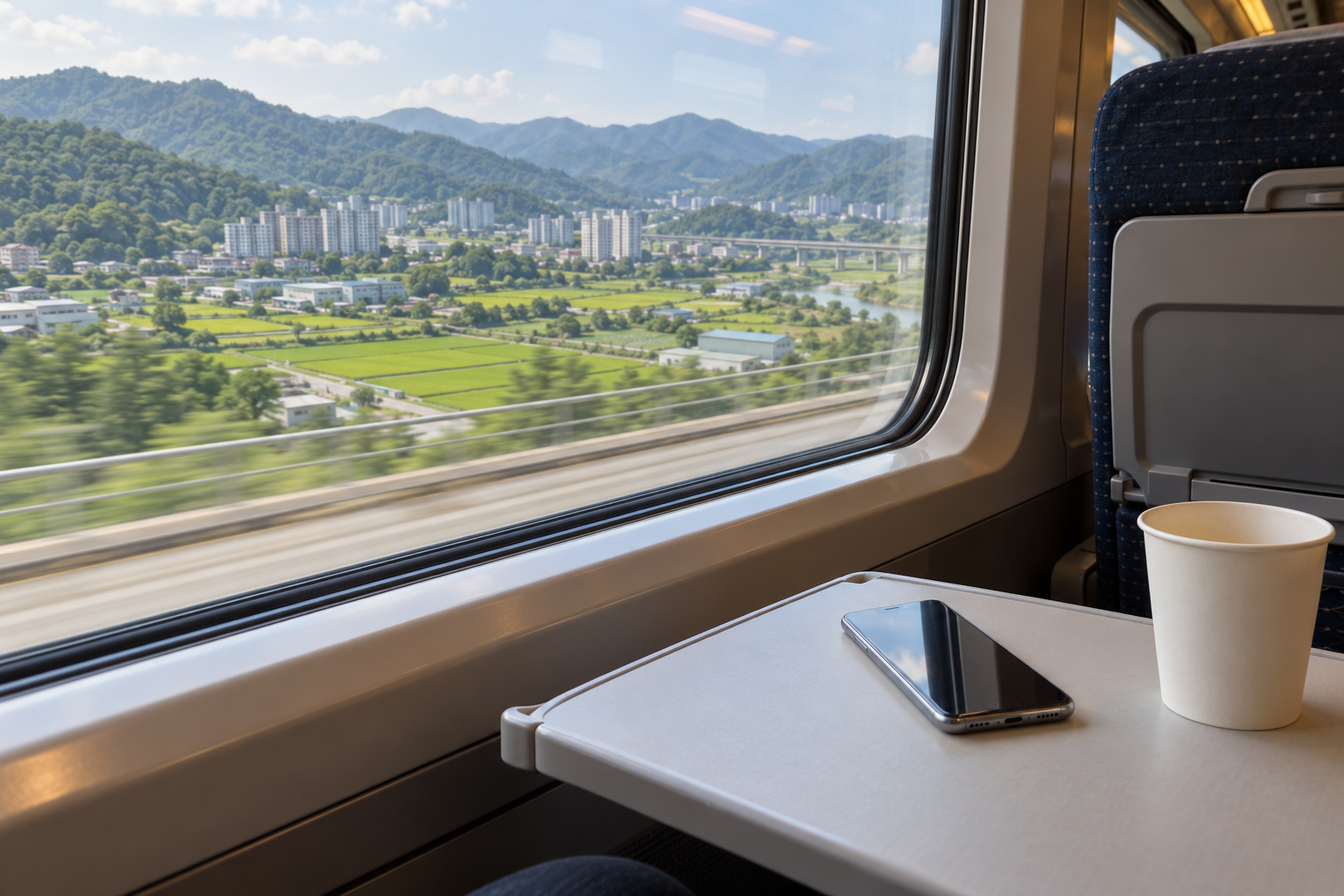
Busan Station sits in the old center of the city and connects underground to Busan Metro Line 1. Visit Busan says the metro has Lines 1–4 plus light rail and the Donghae Line, and runs from about 05:00 to 23:59; first and last trains vary by station.
- Nampo, Jagalchi and Yongdusan Park: stay on Line 1 heading south. Visit Busan’s Line 1 tour lists Jungang and Nampo stations here, and Jagalchi Station is on Line 1 too.
- Seomyeon: Line 1 heading north. Seomyeon is also where you change to Line 2.
- Haeundae Beach: change at Seomyeon to Line 2 and ride to Haeundae Station. Visit Busan says the beach is about a 15-minute walk from Exit 5.
- Gamcheon Culture Village: Visit Busan links it to Toseong Station on Line 1.
Pay with a transport card. Visit Busan says Busan’s own card is Hanaro, but T-money and other national cards also work and get transfer discounts when you tap out. Single QR tickets are sold at station machines. With heavy bags or a group, a taxi from the stand outside the station can be easier than changing lines.
9. Checklist before you travel
- Book as soon as tickets open, especially for weekends and holidays.
- Check your departure station: Seoul, Yongsan or Suseo.
- Compare arrival times; pick the faster train if the price is the same.
- Do the Korail Pass math with your real fares before you buy a pass.
- Save your ticket, train number, car and seat offline.
- Load a transport card for the Busan metro.
- Arrive 20–30 minutes early and find your car number on the platform.
Flying into Korea first? See Incheon Airport to Seoul or Gimpo Airport to Seoul. Still choosing a base before the trip south? Read Where to stay in Seoul.
FAQ
How long is the KTX from Seoul to Busan?
About 2 hours 18 minutes on the fastest trains and up to about 3 hours 30 minutes on trains with many stops. Check the arrival time for your train when you book.
How much is a KTX ticket from Seoul to Busan?
Korail’s standard Seoul–Busan fare is 54,400 won one way in standard class since 1 September 2026. Some trains and online specials cost less, and first class costs more.
Can foreigners book KTX tickets online?
Yes. Use Korail’s English booking page or the KORAIL+ app. Tickets usually open one month ahead at 07:00 Korea time.
Is SRT still a separate train?
No. Since 1 September 2026 Korail runs the former SRT trains as KTX-Sancheon from Suseo Station, and you book them in the same Korail system.
Is the Korail Pass worth it for Seoul to Busan?
Not for a single return trip: two standard tickets cost 108,800 won and the cheapest pass is 131,000 won. It can pay off if you take more long rides on your pass days.
Which Busan subway line is at Busan Station?
Line 1. Change at Seomyeon for Line 2 to Haeundae.
Sources
- Korail press release, “코레일, 9월부터 고속철도 통합 운영” (high-speed rail integration from September), 5 August 2026, checked 15 October 2026.
- Korail press release on the KORAIL+ app launch and Korea.kr government news on the KTX–SRT integration, 3 August 2026, checked 15 October 2026.
- Korail, About Korail Pass (prices and conditions) and Korail English ticket reservation, checked 15 October 2026.
- VISITKOREA, Train guide (page last updated 7 August 2026), checked 15 October 2026.
- Visit Busan, Transportation, checked 15 October 2026.
- Chosun Ilbo, “Seoul-Busan KTX Travel Time Rises 9 Minutes”, 28 September 2026 (news report used for travel-time range).
- Wikimedia Commons image pages: KTX-I at Seoul Station, Busan Station waiting hall.
Update triggers
- Korail changes the Seoul–Busan fare, discounts or the three-year fare plan after the merger.
- Korail Pass prices, coverage of former SRT trains, or seat-reservation rules change.
- The KORAIL+ app or Korail English website changes how foreigners book or pay.
- Timetables change the fastest or slowest Seoul–Busan travel time.
- Busan Metro hours, fares or card rules change.

.jpg)