
Food Delivery to a Seoul Hotel: Ordering, Lobby Pick-Up and the Rubbish Afterwards
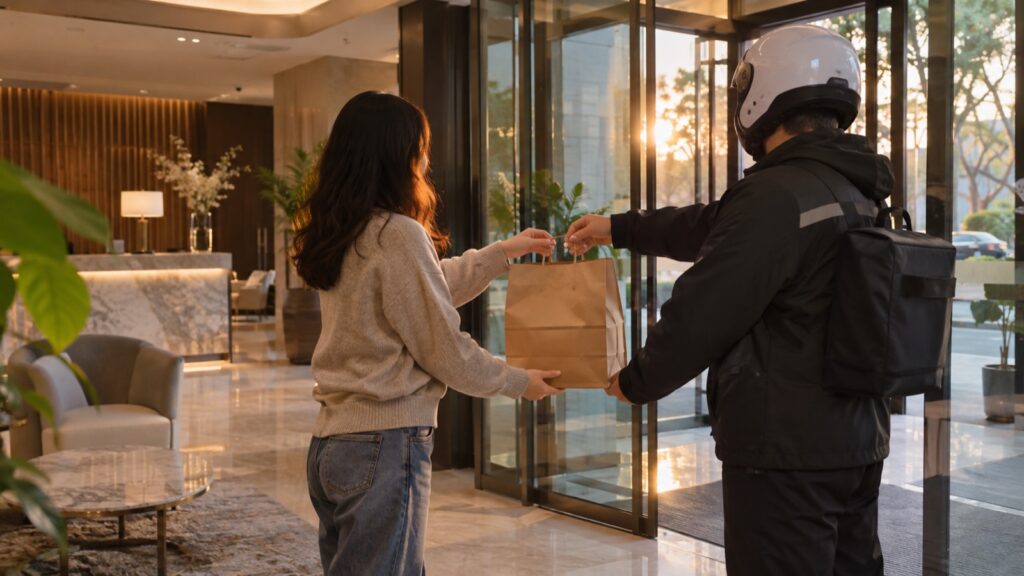
Yes, you can have food delivered to a hotel in Seoul, but in most hotels it does not come to your room. The rider stops at the lobby and you go down to collect it, and a few hotels do not accept delivery orders at all. Ordering is now possible without a Korean phone number. As for the rubbish, pack it up and leave it inside your room for housekeeping; do not put it in the corridor unless the hotel tells you to.
Sorting only becomes your job where nobody cleans the room for you, such as an apartment or a short-term rental.
Find out the hotel’s rule before you order
Hotels in Seoul do not share one policy, and only some of them publish it. Three that do show how far apart the rules can be:
| Hotel | Food from outside in the room | Delivery orders |
|---|---|---|
| Lotte Hotel World (Jamsil) | Allowed | Accepted, but you must collect the food in the lobby on the 1st floor |
| Sotetsu Hotels The Splaisir Seoul Dongdaemun | Your own food and alcohol are allowed | Not accepted; its FAQ names chicken and pizza delivery as examples |
| L7 Myeongdong | The FAQ does not say; outside food, apart from drinks, is not allowed in the guest lounge | The FAQ does not say; ask before you order |
The third row is the common case. Most hotel websites say nothing about delivery, which means the answer is at the front desk. Ask two things at check-in: whether delivery orders are accepted, and where riders hand them over. If a hotel refuses delivery, buying the same meal as takeaway and carrying it in is usually still fine, as the Sotetsu rule shows.
Where a hotel says lobby, it means it at every hour. Do not expect an exception late at night or in bad weather.
Ordering without a Korean phone number
This used to be the hard part for visitors. Baemin, which calls itself Korea’s No.1 food delivery app, now has a page and an app set-up aimed at them. That page says the app works in English, Japanese and Chinese, accepts foreign credit cards as well as WeChat Pay and Alipay+, and needs no Korean phone number. It also says the delivery fee and any other charges are shown before you confirm, and that you can follow the order from the restaurant to the door.
A second option is Shuttle, a smaller service that runs fully in English and Korean. It serves Seoul and four other cities, takes credit cards and PayPal, and lists its hours as 10:00 to 22:00 every day. Enter your hotel’s address first to see whether it is inside the delivery area before you plan dinner around it.
Whichever app you use, the address is where hotel orders go wrong. These steps prevent most problems:
- Copy the hotel’s address in Korean from your booking confirmation or the hotel’s Korean web page, and paste it. A romanised address can fail to match.
- Put the hotel’s name in the address detail field, with your room number only if the hotel has told you riders may come up.
- In the note to the rider, write where you will meet. This Korean line is enough: 호텔 로비에서 직접 받겠습니다 (I will collect it myself in the hotel lobby).
- Pay in the app. Then nobody has to deal with cash or a card reader at the entrance.
If the app asks for a contact number and you have only a foreign one, read our guide on whether you need a Korean phone number before you rely on calls from a rider.
Meeting the rider
Watch the order tracker and go down a few minutes before the estimated time. A rider who finds nobody in the lobby may leave the bag at the entrance or on the front desk, and then nobody is sure whose it is.
Tell the front desk as you pass that an order is on its way to you. Staff who know your name and room can point the rider to you. Do not ask them to receive or pay for the food on your behalf unless the hotel offers that itself.
Eat in your room, not in the lobby or a shared lounge, unless the hotel says otherwise. If you need to reheat something, ask whether there is a guest microwave. L7 Myeongdong, for example, has one in its lounge on the 3rd floor that is open 24 hours a day.
Clearing up afterwards
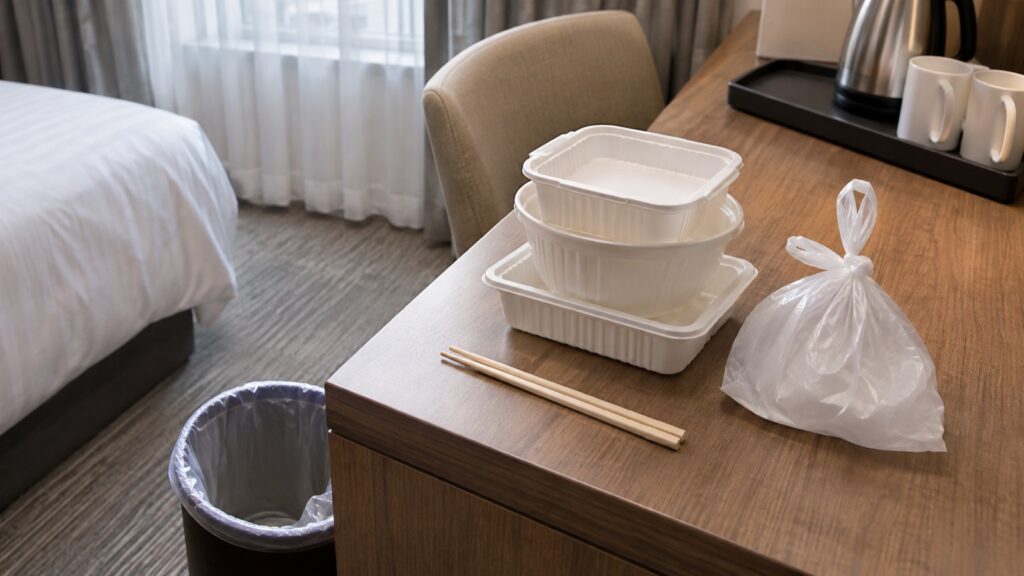
In a hotel, the rubbish from a delivered meal is removed when the room is cleaned. None of the hotel pages checked for this article lists a charge for that, and none asks guests to sort it. What helps is leaving it in a state that does not smell or leak:
- Do not pour soup into the bin. Clear broth can go down the toilet; anything thick or oily stays in its container with the lid on.
- Put leftover food back into one container and close the lid.
- Stack the empty containers, put everything in the bag the meal came in, and tie it.
- Leave the bag beside the bin inside your room, not in the corridor.
A bag left outside the door is the one habit to avoid. It sits in the corridor, and the smell reaches other rooms. If a hotel wants trays or bags left outside, it will say so; ask if you are unsure.
If you have asked for no cleaning during your stay, the bag will not be collected. Take it to the front desk or ask housekeeping to pick it up, and do this the same evening when the meal was fried chicken or seafood.
Apartments, residences and rentals: here you do sort
Once you stay somewhere with no daily cleaning, Seoul’s household rules apply to you. General rubbish goes out in the district’s own paid bags, food waste is collected separately under the district’s or the building’s own system, and recyclables are separated by material. Collection days and places differ by district, so follow the host’s or building’s written instructions, and ask for them if none were given.
The step visitors get wrong is deciding what counts as food waste. Under the standard Seoul published in 2022, items that cannot be processed go in general rubbish, not food waste. After a delivery meal, that means:
| Goes in food waste | Goes in general rubbish |
|---|---|
| Leftover rice, noodles, meat and vegetables, drained of liquid | Chicken, pork and beef bones, and fish bones |
| Soft fruit peel | Shells of clams, crab and other shellfish; onion and garlic skins, spring onion roots and chilli seeds |
| Leftover side dishes | Eggshells, tea leaves, and hard fruit stones such as peach stones |
| Wooden chopsticks, toothpicks, straws, foil and anything plastic mixed in with the food |
Rinse plastic containers before they go into recycling. A container still coated in sauce does not belong there. Seoul has issued its food waste guide in 10 foreign languages, including English, Chinese and Japanese, so a host or building office may be able to give you a copy.
The three questions, answered briefly
- Can the rubbish go outside the room door? In a hotel, keep it inside the room unless staff tell you otherwise. In a rental, it goes to the building’s collection point.
- Does it need sorting? Not in a hotel room. Yes in an apartment or rental, following the district’s rules.
- Is it free? The hotels checked here list no fee. In a rental you pay through the district’s rubbish bags or the building’s system; ask the host what is provided.
For nights when delivery is not worth the effort, see what food costs per day in Seoul and what to do when the hotel rate has no breakfast. If you want the hotel’s delivery rule in writing before you arrive, emailing the hotel after booking is the way to get it.
Pages behind this advice
Checked 15 November 2026.
- Baemin: page for international visitors (languages, payment methods, fees and tracking)
- Shuttle Delivery: service areas, payment methods and hours
- Lotte Hotel World: FAQ (take-out food and lobby pick-up)
- Sotetsu Hotels The Splaisir Seoul Dongdaemun: FAQ (own food and delivery)
- L7 Myeongdong: FAQ (lounge rules and microwave)
- Seoul Metropolitan Government: unified standard for what is not food waste (Korean)
- Seoul Metropolitan Government: food waste guide issued in 10 foreign languages (Korean)