
How Much Korean Won Cash to Bring for 3, 5 or 7 Days in Seoul
My answer is about 100,000 won in cash for three days in Seoul, 150,000 won for five and 200,000 won for a week, as long as you also carry a card that works abroad. That is less than most people expect, because I pay for almost everything here by card. You will not need cash for hotels, restaurants or shopping. You need it for topping up a T-money card, eating at market stalls, and the odd small shop with no card reader. The cash in my own wallet lasts for weeks.

So how much for three, five or seven days?
These are my own rule-of-thumb figures, not an official budget. They assume you pay for your hotel, sit-down meals, cafés and shopping by card, and use cash only for the things below.
| Cash for | 3 days | 5 days | 7 days |
|---|---|---|---|
| T-money top-ups, including the airport train both ways | 25,000 won | 35,000 won | 45,000 won |
| Market stalls, street food and small shops | 30,000 won | 60,000 won | 90,000 won |
| A spare in case a card is refused | 50,000 won | 50,000 won | 50,000 won |
| Roughly | 100,000 won | 150,000 won | 200,000 won |
The transit line is arithmetic, not a guess. A subway ride in the Seoul area is 1,550 won by transport card for the first 10 km, so three rides a day comes to about 4,650 won. The airport all-stop train from Seoul Station to Incheon Terminal 1 is 4,750 won each way before any city leg. Add those up for your days and round up.
The market line is my judgement. If you plan to graze your way through a market every day, raise it. If markets are not your thing, halve it. When I take guests to a market, they always want three or four things from different stalls, and that is where the small notes go.
When will you actually need cash?
Korea’s tourism organisation puts it plainly: most shops take Visa, Mastercard, JCB, AMEX and UnionPay with no minimum, but traditional markets and street shops may only accept cash. That matches what I see every week.
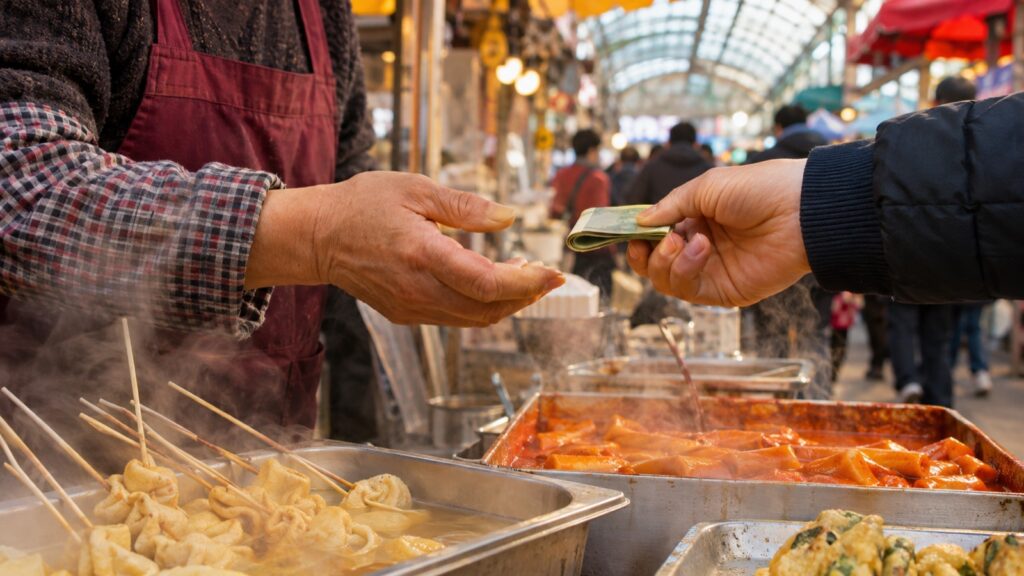
- Topping up T-money. The station machines and convenience store counters take Korean won notes for this. I used to add 10,000 won at a time, and having that note ready saved a lot of fuss. I have watched more than one guest stand at a station machine hunting for the slot to put a credit card in. There isn’t one for this.
- Market stalls and street food. Many stalls now have a card reader, but not all of them, and at a busy counter a small note is faster for everyone.
- Tiny, old-style shops. A neighbourhood shoe repairer, a stall selling socks outside a station. You will not meet many, but when you do, there is no card option.
What surprises friends visiting from abroad is the opposite problem. They arrive with a thick envelope of won and then find they cannot spend it: the café has a self-order kiosk, the restaurant has a tablet on the table, and both want a card. More than one has flown home with most of their cash still in that envelope.
Can you get through a day without cash?
- Hotels, chain restaurants, cafés, convenience stores and department stores.
- Self-order kiosks and table tablets, which are usually card only.
- Single-journey subway tickets and Climate Card passes. Since March 2026, Seoul has 440 newer machines at 273 stations on Lines 1 to 8 that accept international Visa and Mastercard for these, with a fee of about 3.7%.
So, mostly, yes. Honestly, though, I would not pay that 3.7% for every ride. If you are staying more than a day or two, a T-money card with a cash top-up is still simpler.
What if your card is refused?
The real risk in Seoul is not running out of cash. It is a foreign card being refused at one particular terminal. I have stood next to guests at a café kiosk when it happened: the first card bounced, the second went straight through, and nobody behind us even noticed. There is rarely an explanation anyone at the counter can give, even with the Visa sign right there on the door.
So my advice is two cards from different banks, kept in different places, plus that 50,000 won spare. When the first card fails, you hand over the second and nobody minds. Do not leave the physical cards at the hotel and rely on your phone alone; phone payments set up abroad often do not work on Korean terminals.
Should you change money at home or in Seoul?
- ATMs: look for ones marked “Global” or with your card network’s logo. Many are open 24 hours and most have English, Chinese and Japanese menus. ATMs in convenience stores tend to charge more.
- Exchange booths: the government-certified ones show a “Certified” sign with currency symbols and open outside bank hours in areas visitors use.
- Banknotes: 1,000, 5,000, 10,000 and 50,000 won. Ask for some 10,000 and 1,000 won notes. A 50,000 won note handed over for a 3,000 won snack can leave a stall short of change.
At home, change only a small amount, enough for the airport train and a first top-up, and take the rest from an ATM in Seoul if you need it. You are unlikely to need much.
What do you do with the won left over?
- Spend it on the airport train and a last convenience store run.
- Get the T-money balance refunded at a convenience store before you fly. I have done this myself and it took a few minutes.
- Keep a note or two if you will be back.
For how cards, tax refunds and T-money fit together, see money and payment in Korea. For daily meal costs, see Seoul food budget per day. For topping up and refunds, see T-money top-ups and refunds, and for a market where small notes help, what to eat at Gwangjang Market.
Pages behind this advice
Checked 18 November 2026.
- VISITKOREA: Shopping in Korea (cards accepted, markets and street shops may be cash only)
- Seoul Metropolitan Government: transit machines accepting international cards (440 machines, about 3.7% fee)
- Visit Seoul: Money (banknotes, Global ATMs, certified exchange booths)
- AREX: all-stop train fares (Seoul Station to Incheon Airport)
- T-money: guide for foreign visitors (top-up amounts and cash)
- Korail: metropolitan subway fares (1,550 won base fare by transport card)