
Gwanghwamun Square and Cheonggyecheon Stream: Which Exit, and How Long Should You Walk?
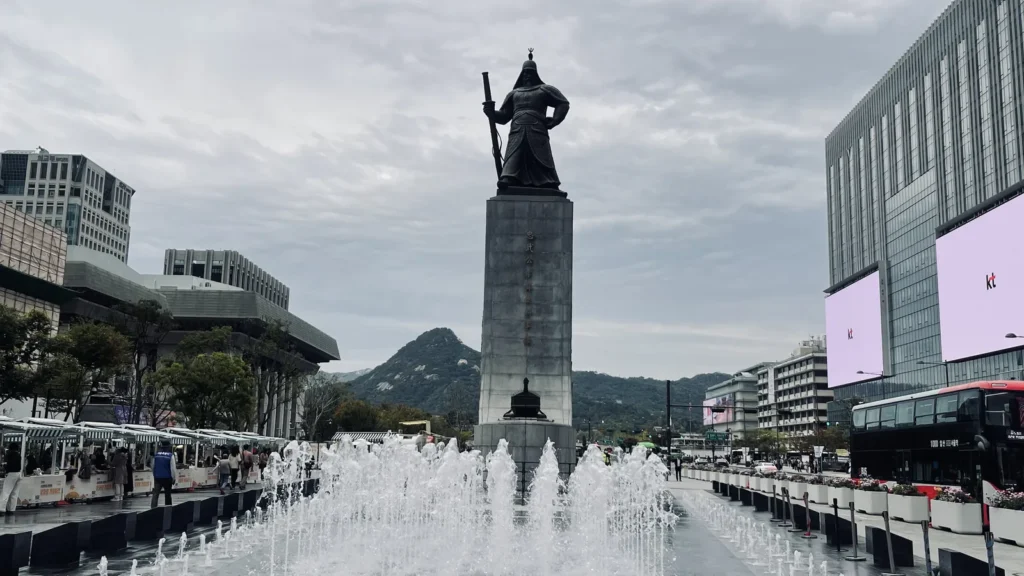
For a first walk through central Seoul, I recommend taking Line 5 to Gwanghwamun Station, walking north through the square, then turning back south to Cheonggye Plaza and the first few bridges along Cheonggyecheon. It is an easy route to shorten whenever your feet or your schedule ask you to.
The square stays open 24 hours and the two underground exhibition halls are free; the halls are the only part with a clock on them: 10:00 to 18:30, last admission 18:00, closed on Mondays. If you have two hours, start indoors and finish by the water. That order keeps the timed visit from becoming a rushed afterthought, and the stream is the part that still works after dark.
When this short central Seoul walk fits
On a spare morning, afternoon or evening in central Seoul, this is a flat walk with no ticket or reservation to arrange. I would use it on a first day, during a jet-lagged evening, or in the hour before or after a palace visit.
I keep the palace separate from this walk. Gyeongbokgung sits directly north of the square and has its own tickets, hours and guard ceremony, which are covered separately in the Gyeongbokgung Palace guide. Treat the palace as the optional next stop, not as part of this walk.
Choose the walk that fits your time
| Your situation | What I’d pick | Why |
|---|---|---|
| About one hour, any day | Square statues, then Cheonggye Plaza and the first bridge or two | Everything is outdoors, free and open at all hours, so nothing can be closed when you arrive. |
| About two hours, Tuesday to Sunday, arriving before 17:00 | Exhibition halls first, then the square, then the stream | The halls stop admitting visitors at 18:00. The square and the stream have no closing time. |
| Monday | Outdoor route only | The exhibition halls close on Mondays. If Monday is a public holiday they open and close the next weekday instead. |
| Evening only | Start at the square, finish at the stream | Cheonggye Falls at the head of the stream runs 24 hours all year, and the plaza fountains are lit at night. |
| Cold, wet or very hot day | Exhibition halls, with a short look at the square | The halls are underground and indoors, and an underground passage links the station to the square. |
| Half a day and good shoes | Follow the stream east toward Gwangjang Market | Seoul’s official guided walking tour covers Cheonggye Plaza to Gwangjang Market and is listed as a two-hour course. |
| You also want the palace | Palace first, then this walk southward | The palace has fixed hours and a ticket. The square and the stream can absorb whatever time is left. |
From Gwanghwamun Station to Cheonggyecheon
All stations, exits, hours and distances below come from the official pages listed at the end of this guide, checked 12 November 2026.
Start at Gwanghwamun Station on Line 5
Gwanghwamun Station is on Subway Line 5. The official Gwanghwamun Square site gives this direction: walk from Gwanghwamun Station Exit 7 toward the Forest Square section, or use the underground passageway to the Haechi area, which opens straight onto the square. VisitSeoul, the city’s official travel guide, measures the square from Exit 2 instead and puts it 235 m away, with the exhibition hall entrance about 30 m from the same exit.
Both are official, so the practical answer is this: inside the station, follow the signs for Gwanghwamun Square. If you want the exhibition halls first, Exit 2 is the one VisitSeoul names for them.
I have met friends at this station more times than I can count, and I never give them an exit number as the meeting point. I tell them to follow the signs up to the square and wait by the Admiral Yi statue. It is the one landmark nobody misses, even when the square is busy.
There are two alternatives. On Line 3, the square’s official site says to walk from Gyeongbokgung Station Exit 6 toward the Government Complex and Gwanghwamun Gate, which brings you in at the northern, palace end. On Line 1, VisitSeoul lists Jonggak Station Exit 1 for the exhibition halls. If you are new to the network, the Seoul subway guide explains transfers, and the T-money guide covers paying the fare.
Walk north through the square
Officially, the address is 172 Sejong-daero, Jongno-gu, and the city describes the square as a downtown public space that stays open 24 hours a day. There is no gate and no ticket.
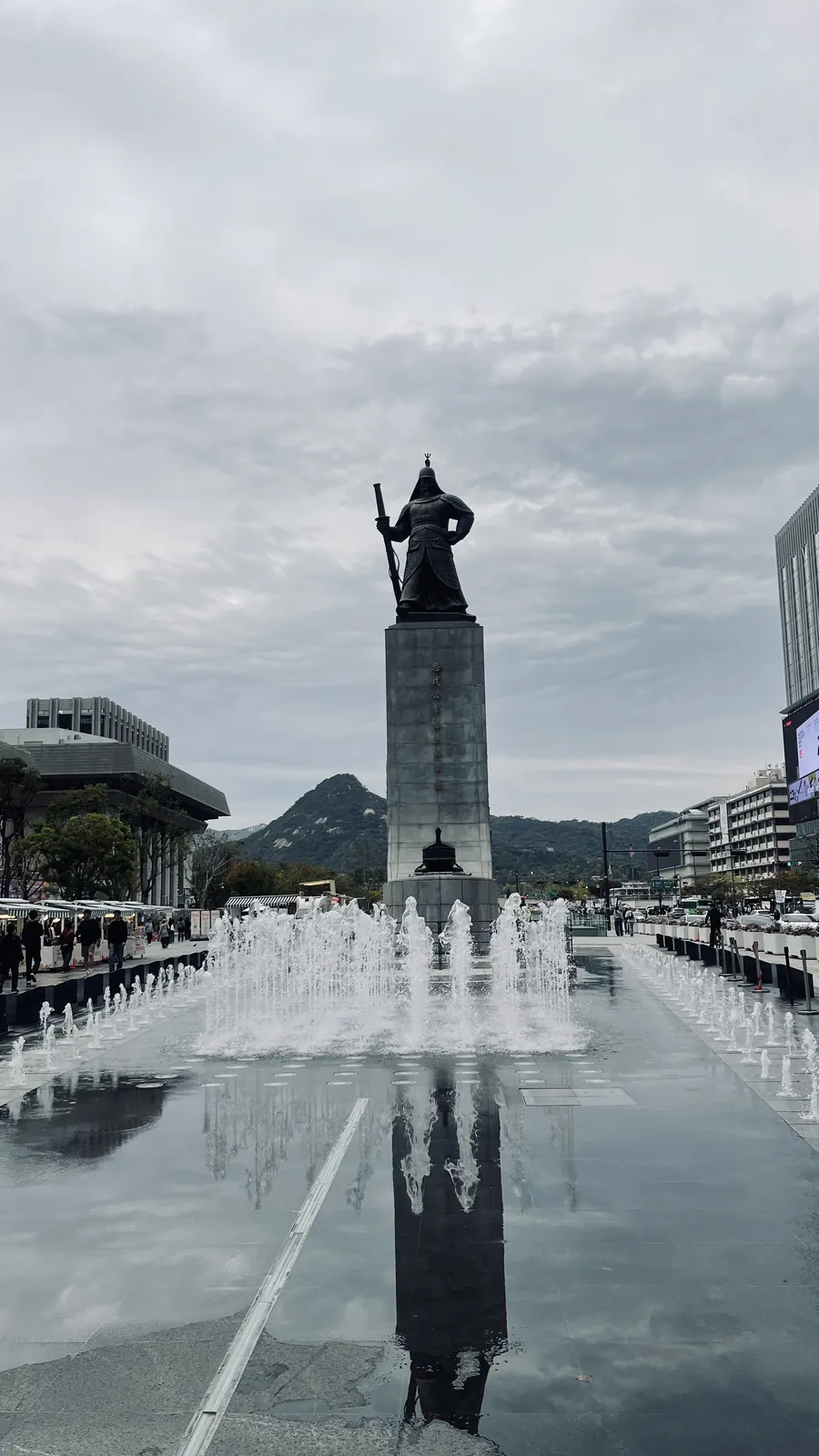
Two statues give the square its shape. The statue of Admiral Yi Sun-sin stands at the southern end, nearer the station. The statue of King Sejong the Great, the king credited with creating Hangeul, the Korean alphabet, sits further north. Beyond it the square runs up to Gwanghwamun Gate, the main gate of Gyeongbokgung.
The square was rebuilt and reopened in August 2022. According to the city, the renovation added digital and multimedia features and restored the Woldae, the ceremonial stone platform in front of the gate. The city also uses the square for festivals and public events, so part of the open space may be taken up by a stage or booths on the day you visit.
Living in Seoul, I always check what is on at the square before I bring guests on a weekend. Saturdays in particular can bring a stage, a march or loudspeakers to one end of it. That never stops the walk, but on those days I keep the square short and give the extra time to the stream, where it is quieter.
How long you spend here is a judgement call. If the square is only a link between the station and the stream, I’d allow 20 to 30 minutes. If you plan to walk all the way up to the gate and back, allow more.
Visit the two free underground exhibition halls
Under the square are two connected exhibition halls run by Sejong Center: The Story of King Sejong, in the basement of the square itself, and The Story of Admiral Yi Sunshin, on level B2 of the Sejong Center building beside it. VisitSeoul says one entrance is behind the King Sejong statue and another is on the Sejong Center side.
- Hours: 10:00 to 18:30, last admission 18:00
- Closed: Mondays. When Monday is a public holiday, the halls open that day and close on the next weekday.
- Admission: free
- Enquiries: 02-399-1177 (Sejong Center)
Sejong Center lists 12 exhibition areas on the King Sejong side, including the creation of Hangeul and science and art under his reign, and six on the Admiral Yi side, including the ships of the Joseon navy and a 4D experience room. The centre also lists stroller and wheelchair rental and a rest area called the Hangeul Lounge.
The halls are the only part of this route that can be shut when you arrive. On a short winter afternoon I’d go here first and save the outdoor sections for afterwards.
Turn south along Sejong-daero to Cheonggye Plaza
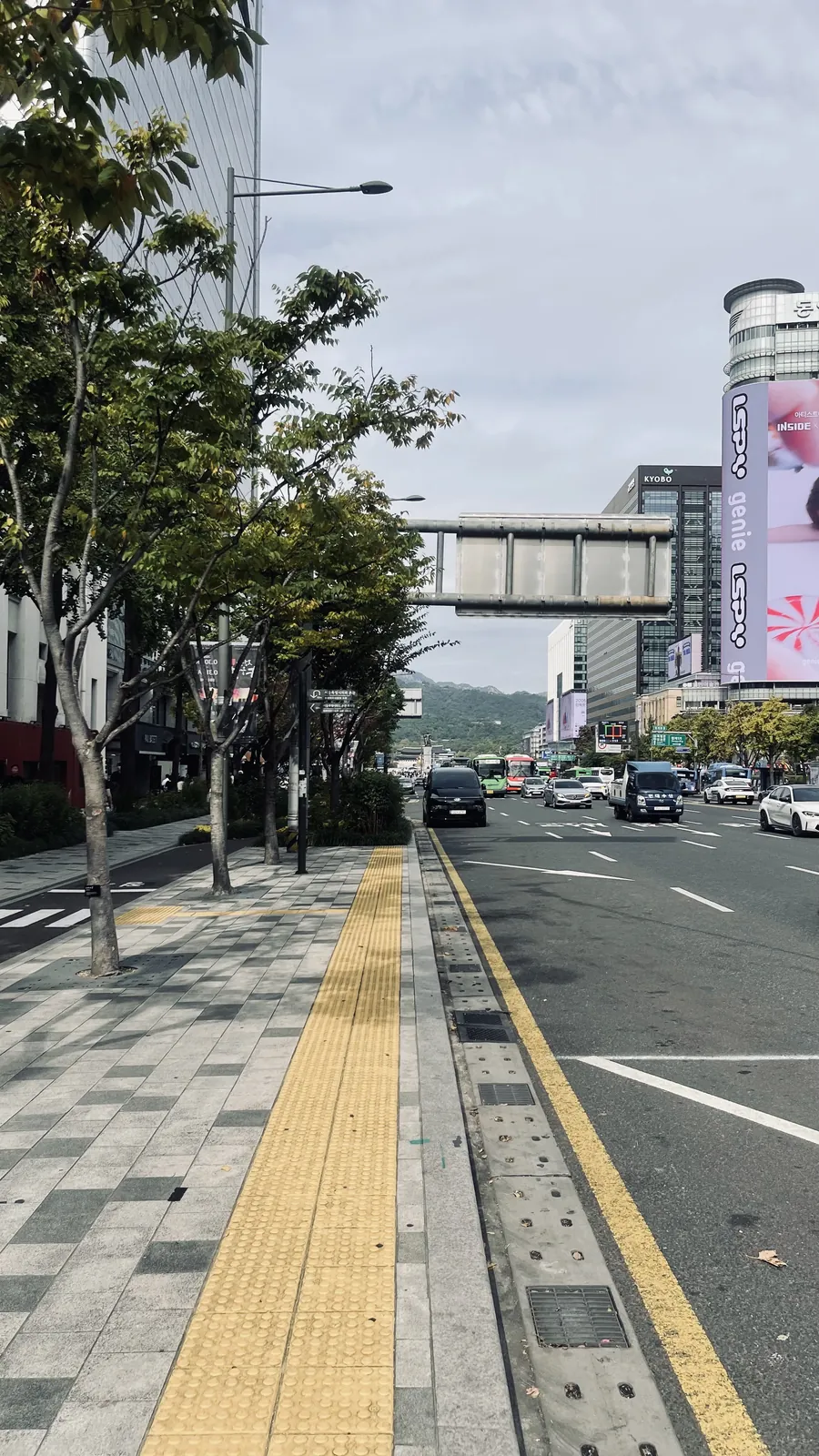
From the Admiral Yi statue, continue south along Sejong-daero, the wide avenue that runs through the square. Cheonggye Plaza sits just off this avenue, where the stream begins. Look for the Spring tower, the sculpture that VisitSeoul names as one of the plaza’s two main features along with the Candlelight Fountain.
If you are coming only for the stream, VisitSeoul’s guided walking tour of the stream uses Gwanghwamun Station Exit 5 as its meeting point for Cheonggye Plaza.
Follow Cheonggyecheon at your own pace
According to the Korea Tourism Organization, Cheonggye Plaza is 160 m long and 50 m wide, with a two-tier waterfall that drops four metres into the stream. You reach the water by stairs on the left side of the plaza or by the Cheonggye Trail on the right, which includes an 18 m tunnel.
Seoul Facilities Corporation, which manages the stream, gives its length as 10.84 km. The restored section runs about 5.8 km, from the Dong-A Ilbo building at Gwanghwamun to Sindap Railroad Bridge in Seongdong-gu, and was completed on 1 October 2005 with 22 bridges. Walking east from the plaza, the first six are Mojeongyo, Gwangtonggyo, Gwanggyo, Jangtonggyo, Samilgyo and Supyogyo.
You do not need to walk the whole stream. If you have an hour, I’d turn around at Gwangtonggyo or Gwanggyo and climb back to street level there. If you have half a day, VisitSeoul’s guided course is a useful model: Cheonggye Plaza, Gwangtonggyo, Samilgyo, Supyogyo, Saebyeokdari and Gwangjang Market, listed at two hours.
My own habit is to stay down on the stream path rather than the pavement above. Once you are by the water the traffic noise drops away, and on a summer afternoon the path feels noticeably cooler than the street. Wear shoes with some grip, though: the stepping stones and the stone edges by the water can be slippery after rain.
What the route costs
- Gwanghwamun Square: free, open 24 hours
- The Story of King Sejong and The Story of Admiral Yi Sunshin: free
- Cheonggyecheon Stream: a public walkway, open all year
- Your only spend is the subway fare to get there and back
What changes after dark
Nothing on this route shuts at night; it simply changes shape. The exhibition halls stop admitting visitors at 18:00, so anything indoors has to come first. The square stays open all night.
On the stream, Seoul Facilities Corporation publishes a schedule for the water features. Cheonggye Falls at the head of the stream runs 24 hours a day, all year. The fountain at the stream’s starting point runs from 1 April to 15 November, 12:00 to 21:00, in cycles of 50 minutes on and 10 minutes off. The Digital Canvas at Gwanggyo is listed for 1 March to 30 November, 19:00 to 21:00, in eight-minute shows every half hour, shifting to 20:00 to 21:30 from May to September.
Two things follow from that schedule. From December to February, expect the waterfall and the lit plaza but not the fountain or the light show. And in the warmer months, an evening walk that reaches Gwanggyo around 19:00 or 20:00 gets more out of the stream than a midday one.
If evenings in this part of the city appeal to you, staying nearby makes the walk an easy after-dinner option. The guide to where to stay in Seoul for a first visit compares the central neighbourhoods.
Small choices that save backtracking
- Trusting a single exit number. Official sources name different exits for different targets: Exit 7 or the underground passage for the square, Exit 2 for the exhibition halls, Exit 5 for Cheonggye Plaza. Decide what you want to see first, then pick the exit.
- Arriving for the exhibition on a Monday, or after 18:00. The outdoor route still works. The halls do not.
- Mixing up the two stations. Gwanghwamun Station is Line 5 and puts you at the southern end. Gyeongbokgung Station is Line 3 and puts you at the palace end. Either works, but they start the walk from opposite directions.
- Planning to walk the whole stream. The restored section alone is about 5.8 km one way. The first few bridges give you the idea.
- Expecting fountains in winter. The starting-point fountain is scheduled only until 15 November and the Digital Canvas until 30 November.
- Treating the square as the palace. The gate at the north end is the entrance to Gyeongbokgung, a separate ticketed site with its own hours.
Questions before you set out
Is Gwanghwamun Square free, and does it close at night?
It is a public city square with no admission charge, and the city describes it as open 24 hours a day, all year. Only the underground exhibition halls keep hours: 10:00 to 18:30, closed Mondays, also free.
Which subway exit is closest to Cheonggyecheon Stream?
For Cheonggye Plaza, where the stream starts, VisitSeoul’s guided walking tour meets in front of Gwanghwamun Station Exit 5 on Line 5.
Can I do Gwanghwamun Square, Cheonggyecheon and Gyeongbokgung on the same day?
Yes, they sit in one straight line. If the palace is on your list, I’d give it the fixed slot in the day and fit this walk around it, because the square and the stream never close. Palace tickets, hours and the guard ceremony are in the Gyeongbokgung Palace guide.
Official sources
All checked 12 November 2026.
- Gwanghwamun Square (Seoul Metropolitan Government): Directions — address, 24-hour opening, Line 5 and Line 3 exits
- Gwanghwamun Square (Seoul Metropolitan Government): Introduction — August 2022 reopening, Woldae
- Sejong Center: The Story of King Sejong and The Story of Admiral Yi Sunshin — hours, closed days, hall locations, exhibition areas
- VisitSeoul: Gwanghwamun Square — free admission, Exit 2 distance, exhibition entrances
- VisitSeoul: The Story of King Sejong and The Story of Admiral Yi Sunshin — hours, free admission, station exits
- Seoul Facilities Corporation: Cheonggyecheon (Stream) — length, restored section, bridges, fountain and light schedules
- VisitKorea (Korea Tourism Organization): Cheonggyecheon Stream — Cheonggye Plaza dimensions, access stairs and trail, open all year
- VisitSeoul: Cheonggyecheon guided walking tour — Exit 5 meeting point, route, two-hour course